Where does Go shine?
Go is a compiled, statically typed programming language with a lean toolchain. It is a strong choice for network services, CLI tools, infrastructure software and applications that can be shipped as a single compiled binary. A relatively short build-and-start cycle, together with the HTTP, JSON and testing tools in the standard library, makes small services easy to build. None of this proves it is the fastest language under every workload. Go’s value should be judged by measuring team productivity, ease of deployment, resource usage and service behavior together.
Goroutines and channels can structure concurrent work, but that does not make concurrency and parallelism the same thing. Concurrency is about managing the progress of multiple tasks; parallelism is running on more than one CPU core at the same time. A network service with many waiting requests can benefit from goroutines. In a CPU-heavy loop, spawning goroutines without capping the number of workers increases memory usage, not performance.
The small standard library is an advantage in the Go ecosystem, but avoiding every dependency is not the goal. A router, a data access package or an observability tool can be added when there is a real need. Learning the flow with modules and the standard library first lets you see which problem a third-party abstraction actually solves. Consider your target runtime, deployment platform and team experience.
Modules, packages and file layout
A new project establishes its module boundary with go mod init example.com/product. A module is the unit, described by its name and dependency information in go.mod, that other code can version and consume. A package is the logical unit of Go source files compiled together in the same directory. A layout such as cmd/server, internal/httpapi and internal/store may be enough to start with; just don’t create empty folders for abstractions that don’t exist yet. In Go, exported names start with an uppercase letter and package-internal names with a lowercase one.
When you add a dependency with go get, check what came in, which version was selected and whether the module is trustworthy. Packages the application doesn’t use enlarge the build graph and the security maintenance burden. Both go.mod and go.sum belong in version control. Check the Modules Reference for how the Go tooling currently resolves versions and handles checksums; choosing a module path that matches the real repository location makes publishing the package easier later.
gofmt enforces a standard format and removes whitespace debates from code review. go vet, tests and lint steps can run in CI. The initial quality gate should stay simple: gofmt -w, go test ./... and, when needed, go vet ./.... Team rules and personal editor habits should not get mixed up; the same change must be evaluated the same way locally and in CI. Learn how go test behaves and how test files are named from the official documentation.
Explicit error values and API design
Go code usually carries errors explicitly by returning (value, error) from functions. The caller checks for an error before using the successful result. The repetition looks verbose at first; in exchange, the error flow is more observable than hidden exception chains. Wrap errors with context using %w so that upper layers can classify them with errors.Is or errors.As. Logging an error and then returning it can produce duplicate log entries; decide at which layer logging should happen.
An expected absence, malformed JSON, an unreachable database and a denied permission are not the same kind of event. In an HTTP application, turning every domain error straight into a 500 makes a user’s fixable input problem look like a server failure. On the other hand, returning an internal SQL message to the user as-is can leak information. Think about domain error types and their HTTP mapping in one place; the error message should carry a safe explanation, while the log carries a correlation ID and the necessary technical context.
The ways a function can fail are part of its API design. Don’t let every layer convert the same error into a different string and lose its origin. Sentinel errors or custom structured errors can be useful, but turning every message into a global constant is not the answer. Sending a stable error code to the client, the details to the logs and a trace ID when tracing is available speeds up investigations. Keep failure cases as visible in your tests as success cases.
HTTP servers: from a simple handler to a reliable service
Go’s standard library net/http provides handlers, middleware functions, and client and server types. An http.Handler receives a request and a response writer; that boundary is easy to exercise with fake requests in tests. Don’t assume an endpoint accepts and returns JSON: content type, body size, empty values, unknown fields, authentication and the request timeout policy all need to be defined. A JSON decoder alone does not validate every business rule.
Setting read, write and idle timeouts on http.Server helps stop slow or stuck clients from holding resources indefinitely. http.ListenAndServe can start a server in one line, but a production service that needs graceful shutdown and custom server settings should use an explicit Server value. Receiving the shutdown signal with signal.NotifyContext and calling Shutdown gives in-flight requests time to finish. Define explicitly whether the health check endpoint means “the process is running” or “dependencies are reachable”.
In handler tests, check the status, headers and body. httptest provides fake HTTP requests and responses for a router or handler; if database behavior matters, cover it separately in an integration test. Real server/client, TLS and proxy settings may need testing at the deployment layer. Don’t just check that the JSON output contains a substring; decode the structure and verify the expected fields and codes.
01mux := http.NewServeMux()02mux.HandleFunc("GET /healthz", func(w http.ResponseWriter, r *http.Request) {03 w.Header().Set("Content-Type", "application/json")04 w.WriteHeader(http.StatusOK)05 _ = json.NewEncoder(w).Encode(map[string]string{06 "status": "ok",07 })08})09 10server := &http.Server{11 Addr: ":8080",12 Handler: mux,13 ReadHeaderTimeout: 5 * time.Second,14}Every goroutine needs an owner, an exit condition and a resource limit.
Goroutines, channels and lifecycles
Putting go in front of a call starts a new goroutine, but it does not decide who will wait for that work, who receives its error or how a cancellation signal will reach it. Starting background work “fire and forget” can leave it half-finished when the service shuts down, or keep it alive forever. A goroutine’s owner, exit condition and resource limit have to be designed. context.Context is the standard tool for passing request cancellation and deadlines down the call tree; make it an explicit function parameter instead of storing it in a struct field or passing nil.
A channel is a tool for exchanging values and synchronizing; you need to agree on its capacity, its closing and its consumer. The sending side usually closes the channel; with multiple senders, a separate coordinator should own the closing responsibility. The (value, ok) result from a closed channel signals that the work is done. A producer writing to a channel that no longer has a receiver can block; a bounded queue and a context-aware select keep that risk in check. Use tests and profiles to find goroutine leaks.
A mutex is not a bad tool. For a small counter or a shared cache, sync.Mutex can be clearer; routing every bit of shared state through channels creates needless complexity. Running Go’s race detector with go test -race ./... catches some data races along the code paths your tests exercise; it does not mathematically prove there are no races. Reduce shared mutable state, run tests in parallel and review critical map and slice usage.
Worker pools: parallel work within resource limits
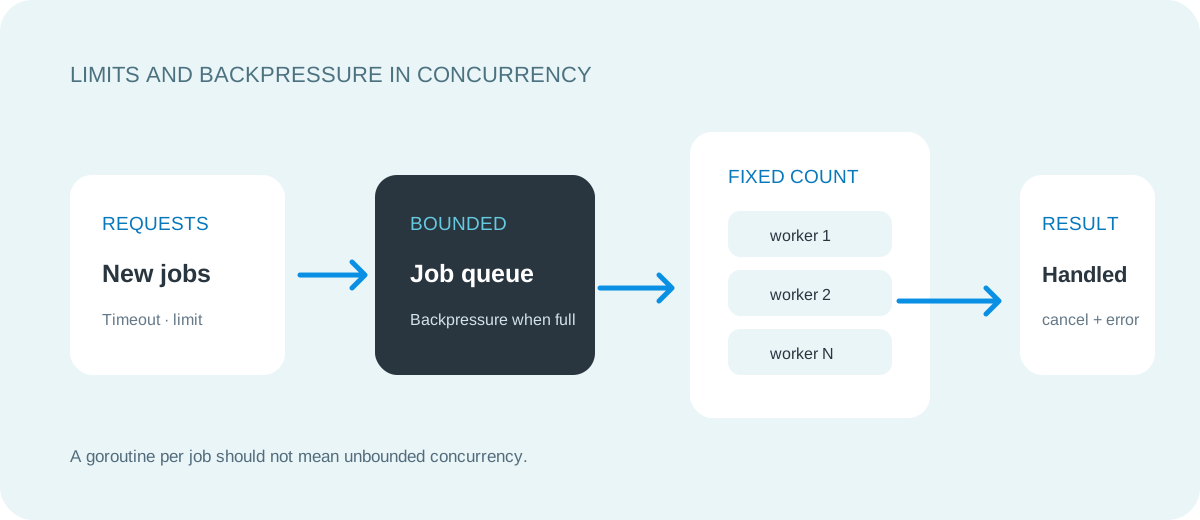
In an image conversion, webhook processing or report generation service, it is easy to hand every incoming job to a new goroutine. When traffic spikes, thousands of jobs can exhaust memory, CPU and downstream connections. A worker pool sets up a fixed number of workers, a bounded job queue and a way to track completion and errors. Don’t pick the capacity by guesswork and forget about it: take CPU cores, the DB connection pool, third-party API limits and real load tests into account.
Define the backpressure behavior: when the queue is full, will you reject new requests, make them wait or hand them off to a message broker? In an HTTP service, signalling overload to the client in a controlled way is better than bloating the server’s memory. Designing jobs to be idempotent makes retries safe. If a job is delivered twice, charges or emails must not be duplicated. A broker brings delivery guarantees, retention, dead-letter queues and operational overhead; add one only to get the semantics you genuinely need.
Instead of sending errors through the channel as plain error values, you can define a result type or consider a package such as errgroup. The standard sync.WaitGroup waits for jobs but does not collect errors or handle cancellation on its own. Set up context, an error channel and the shutdown order explicitly as needed. When the application shuts down, stop accepting new work, wait for in-flight jobs until the deadline, then close resources. That order is part of a graceful shutdown.
Testing, fuzzing and profiling: get evidence from tools
Go test files end in _test.go; test functions are discovered by their Test prefix. Table-driven tests make it easy to exercise the same function with different inputs, expected results and descriptive names. Before using t.Parallel(), make sure tests don’t collide over shared files, global state or ports. You can build pure tests by injecting HTTP handlers and their dependencies through interfaces, but excessive mocking can hide real behavior. Exercise critical data access against a real test database.
Go fuzzing can search for inputs that make functions produce unexpected errors or panics. It is a good complement for parsers, URL handling and any code that takes user input. A fuzz test alone does not guarantee that the meaningful product outcome is correct; define invariants and failure conditions. Use go test -race for concurrent code, and benchmarks for a specific performance question. A single benchmark run on a small machine is not a forecast of production performance. Write down a representative workload and the measurement conditions first.
Collect CPU, heap, goroutine and mutex profiles according to what you are trying to learn. Profile data can contain user data or internal architecture details, so protect how it is stored and who can access it. P99 latency, error rate, queue length and downstream latency can explain service health better than a micro-benchmark. When you add a metric, decide whether its alert threshold will lead to an action. Noisy alerts teach teams to ignore signals.
Sample project: a rate-limited webhook delivery service
As an example, consider a webhook service that receives customer events and forwards them to target URLs. The HTTP layer checks the request’s signature and size, puts the event on a durable queue and returns an accepted response. Workers POST to the registered target with a client that has a timeout, and record the result and the attempt number. Exponential backoff with jitter can be applied depending on the error class; for permanent errors such as 4xx, the retry strategy may differ. These behaviors are not features of the Go language; they are distributed-systems requirements.
Limits: cap the number of workers and concurrent connections to targets; assess the SSRF risk of target hosts; compare signatures with a constant-time library function; never disable TLS verification; don’t log delivery payloads; design for secret rotation. A per-event idempotency key reduces duplicate effects when a client resends the same event. Without a queue, the product contract should state whether an accepted message can be lost if the process crashes.
For an initial demo, SQLite or a mock store is enough; choose a durable broker or database once load and durability requirements emerge. Tests should cover valid and invalid signatures, slow endpoints, TLS errors, redelivery, service shutdown and a full queue. httptest.Server can create a controlled remote endpoint. Rather than faking the whole system between two integration tests, keep a small number of tests that exercise real HTTP behavior.

Good portfolio projects in Go
A daily backup CLI: it hashes files, keeps a manifest, offers a dry run, writes changes atomically and shuts down on signals. A small JSON REST API: Postgres migrations, filtering, pagination, validation and an OpenAPI contract. A WebSocket notification service: a good place to learn about connection lifecycles and backpressure. A thumbnail worker: demonstrates a bounded job queue, processing time and file type validation. If you can’t describe the project in one sentence, the scope may be too broad.
The README should include the supported Go version, setup, environment variables, go test and go run commands, an API example and known limitations. Add a .env.example with no secrets in it; the real .env must stay out of git. Run build, test and race steps in CI according to platform support. While highlighting the single-binary deployment advantage, check cross-compilation and native dependency requirements for the target platform. Don’t expose the application to the internet before it has been security tested.
If you are building a project for a job application or an interview, explain why you chose Go. When the same thing could be done with a shorter script, write down which operational need Go’s static binaries and concurrency model address. If you include benchmarks, note the methodology and the machine. Pointing out that a synchronous flow can be simpler, instead of using goroutines for show, demonstrates engineering judgment.
Common anti-patterns and decision criteria
The main pitfalls: spawning a goroutine for every job without limits; not propagating context cancellation to the next layer; ignoring errors with _; leaning too heavily on global mutable state; letting panics disappear in the middleware chain; not setting timeouts; leaving every boundary vague with interface{}/any; keeping the entire database schema in one giant package. To avoid them, ask in code review about the lifetime of every goroutine, the timeout of every external call and the owner of every error.
Choose Go based on the service protocol, team skills, deployment and cost, third-party dependencies, memory and latency targets, and development speed. For heavy scientific computing, Python’s scientific libraries or Rust’s low-level control may be a better fit. For UI-heavy web work, TypeScript and the browser ecosystem are the natural choice. Go’s simple concurrency model is useful for network services, but it does not automatically simplify the complex rules of a domain model.
The official Effective Go, the Go Tour and the Go tutorials are good starting points. For module behavior and version requirements, rely on the Go Modules Reference; for what’s new in each language version, rely on the release notes. Online you may come across examples of loop variable or module behavior left over from older versions. Compile code snippets with your own Go version and verify them with go test. A Stack Overflow answer without a date or version should not be treated as a universal rule.
For a Go application heading to production, the right outcome is a simple structure, cancellable work, bounded concurrency, understandable errors, automated tests, measurement and safe deployment. Build the first working version with the standard library, and add dependencies and architecture once the load profile becomes clear. Compiling is only the first step of the quality gate. While running, a service should be able to stop itself cleanly, explain its failures and stay within its limits.
Official sources and further reading
To verify technical behavior against primary sources and deepen the topic through practice:
- A Tour of Go
- Effective Go
- Go tutorials
- Go Modules Reference
- Go testing package
- Go
net/httppackage - Go race detector
These sources are the primary documentation for the relevant language, standard library or tool. For details that can change between versions, rely on the documentation for the version your project uses.