What problem does Rust solve?
Rust is a systems programming language that aims to prevent memory safety bugs and data races through compile-time checks, without requiring a garbage collector. That safety claim does not mean every program bug becomes impossible. Wrong algorithms, unauthorized APIs, business rule errors, panics, deadlocks, faulty unsafe blocks and resource exhaustion are all still possible. What sets Rust apart is that it expresses data ownership, borrowing and mutability rules through its type and compilation model, catching an entire class of bugs before the program runs.
It can be a good fit for low-latency services, CLIs, game engine components, parsers, WebAssembly modules, embedded software or resource-critical tools. The learning curve and compile times are part of the total cost of delivery. If a prototype needs a broad scientific library, Python may be more productive; for browser interfaces, TypeScript; for very fast service development and simple deployment, Go. The case for Rust gets stronger when its safety and control advantages create real value for the business requirement.
Rust’s ownership system makes memory lifetimes explicit without a GC. But the design goal is not “avoid clone at all costs”. If an unnecessary copy is expensive, measure it; there is nothing wrong with small Copy values or a deliberate clone that simplifies ownership. When mandatory lifetime annotations pile up, the code’s data ownership model may be too complex; first think about what a struct should own, and who uses a reference and for how long.
A first project with Cargo and a reliable development loop
cargo new scaffolds a binary application and cargo new --lib a library. Cargo manages packages, builds code and runs tests. Cargo.toml holds package metadata and dependencies; Cargo.lock holds the resolved dependency versions. Keeping the lock file in version control for application packages helps with reproducible builds. For library maintenance, a lock file is useful for development and testing, but a library’s lock file does not determine the dependencies of downstream users; follow the Cargo Book’s guidance.
cargo check runs code through fast type and borrow checks, finding errors without linking a full binary. cargo test compiles and runs unit, integration and documentation tests. cargo fmt --check verifies formatting, and cargo clippy flags common mistakes and unnecessary patterns. These commands should be repeated in CI with pinned cargo and rustc versions. Understand whether a Clippy warning is only a style suggestion or a correctness warning; silencing every lint with allow is not a trustworthy gate.
Managing the Rust toolchain with rustup is common. In each project, state the MSRV (minimum supported Rust version), edition and target platform explicitly. A new version of a dependency may not compile with an older compiler. cargo update changes the lock file; review and test the change. When choosing a dependency, research the crates.io package’s maintenance, license, unsafe usage, transitive dependencies and security advisories. Adding dozens of dependencies to a small project for the sake of a single helper function is a maintenance cost.
Ownership and borrowing: the core intuition
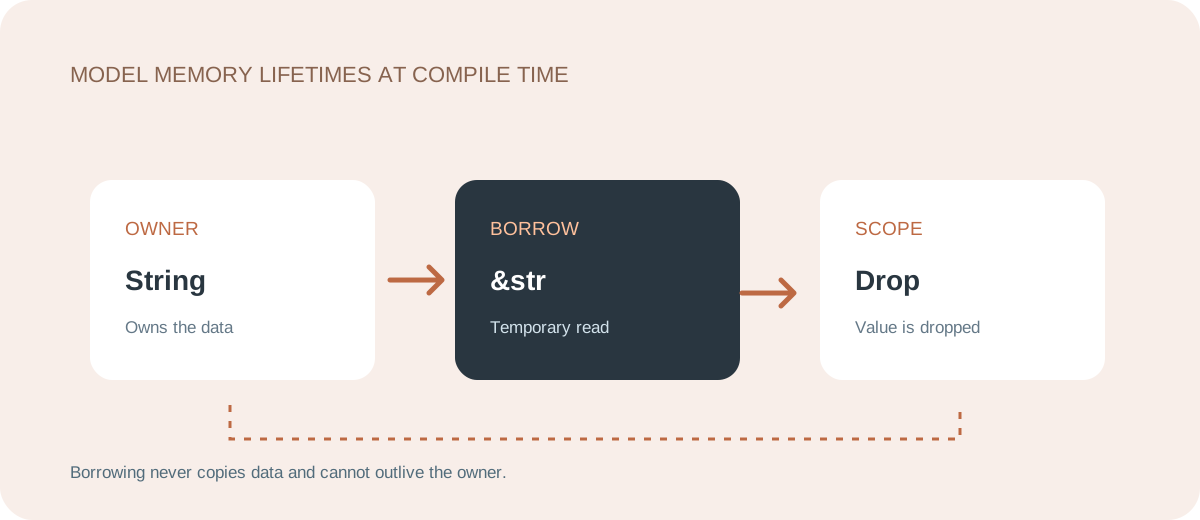
In Rust, every value belongs to exactly one owner’s scope at any given moment; when the owner goes out of scope, the value is dropped. Assigning a non-Copy value to another variable usually transfers ownership (a move), and the old binding is no longer valid. Passing a value to a function also moves or copies it according to the type’s rules; when the function ends, its local owner can be dropped. These rules make it visible when allocations, file handles and other resources are released. Value lifetimes are checked at compile time, so there is no need for manual free calls as in C/C++.
If a function only needs to read, it can take a &T reference; if it needs to modify, a &mut T. The rule of many immutable references or a single mutable reference at any one time reduces aliasing and data race risks. Borrow checker errors can slow your workflow at first; figure out what the message is asking about which data needs to live and for how long. Usually the fix, before memorizing lifetime syntax, is to stop sharing data unnecessarily, to move ownership in and return it, or to split the work into smaller functions.
The difference between String and &str is an instructive example: String holds owned, growable text on the heap; &str holds a borrowed view into existing UTF-8 text. If you don’t want to move a String into a function, accepting a &str parameter is appropriate for most read-only functions. If the output is new, independent text, return a String. When returning a reference, the source must outlive the result; otherwise the compiler rejects the invalid reference.
&str and return a new, owned String when needed.rust01fn greeting(name: &str) -> String {02 format!("Hello, {name}!")03}04 05fn main() {06 let name = String::from("Yunus");07 let message = greeting(&name);08 println!("{message}");09 println!("{name}");10}Reducing invalid states with enums, pattern matching and Option
Rust enums are not just lists of numeric constants; each variant can carry different data. Option<T> says a value is either present or absent; rather than silently adding a null-like value to every type, it pushes the caller to handle the absent case. Result<T, E> carries either a success value or an error value. match checks that every variant is handled. if let or let else gives simpler syntax where only one case matters. With these types, the error path is a visible part of the code.
Deserializing an API response into a Rust struct does not, on its own, show that the incoming JSON satisfies business rules. Serde handles syntactic and structural conversion; range, authorization, ownership and domain validation must be written separately. Decisions such as whether a config field is required, whether a missing value gets a default and whether unknown fields are rejected should follow the contract. unwrap() can be fine for quick prototyping during development, but with untrusted data or I/O errors it can turn into a panic.
In business logic, returning a Result and handling the error in an upper layer according to user, API or logging needs is usually more controlled. The ? operator returns early if the error type can be converted into the caller’s. Defining error types with libraries such as thiserror makes domain errors easier to understand; anyhow can be practical for adding context at the application’s top level. Don’t add either without a need. For library users, the error type is part of the public contract, so think about compatibility when changing it.
The borrow checker exposes not only invalid references but also unclear decisions about data ownership.
Lifetimes: expressing where a reference comes from
A lifetime annotation does not extend a reference’s lifetime or keep memory “alive”. It tells the compiler how input and output references relate to each other. For example, a function that returns the longer of two strings may need a lifetime relationship showing which input the result refers to. Elision rules remove the annotation in simple functions; writing 'static everywhere does not change how long the data actually lives. 'static is for data that genuinely lasts for the whole program, or for suitable literals.
When you hit a lifetime error, check whether the owner of the source data lives until the end of the function, whether the result really needs to be a borrowed reference, or whether returning an owned value such as String/Vec would be simpler. If a struct holds a reference, the lifetime of the external data it depends on constrains how the struct can be used. In long-lived caches or callbacks, this model can complicate the API. If the ownership model is going to change, do it before bolting on lifetimes.
The goal is not to make the entire program lifetime-free; it is to avoid weighing down an API with lifetime annotations when there is no need. Most applications move data around as owned values and use borrowing for short function calls. In performance-sensitive areas such as iterators, parsers and zero-copy libraries, lifetime relationships deliver deliberate benefits. Write clear, correct code first, and optimize copying and allocation behavior once profiling shows a bottleneck.
Concurrency: Send, Sync and data race safety
Rust’s type system places certain safety conditions, through the Send and Sync traits, on data that can be moved or shared between threads. They are not overarching concepts that guarantee a race-free outcome for every parallel program; unsafe code, logical races and deadlocks can still occur. The standard Arc<Mutex<T>> can be used for shared, protected mutable data. Message passing between threads, on the other hand, can reduce shared state by transferring ownership. The choice depends on the data flow and performance requirements.
Async Rust is based on async functions producing a Future; a future does not start running on its own but is polled by an executor. Runtimes such as Tokio provide networking, timers and task scheduling. You don’t need async in every layer of a project. At an async boundary, blocking file or CPU work can tie up executor threads; use an appropriate blocking pool or a separate job queue. Follow the current documentation for the runtime version you use, with its features selected explicitly.
Creating lots of small tasks is no excuse for unbounded resource creation. Define policies for request admission, concurrency limits, backpressure, cancellation and graceful shutdown. Waiting on several futures with select! lets you handle timeouts and shutdown signals together; when something is cancelled, check whether the downstream service was actually cancelled too. Errors in detached tasks may never reach the user. Keep track of each JoinHandle and complete pending work in a manageable way when the service shuts down.
Testing, documentation and the unsafe boundary
cargo test runs unit, integration and doc tests. Unit tests can access the internals of the same module; integration tests exercise the public API by calling the library the way a user would. Code examples inside doc comments can also be doctests; having documented usage compile gives you confidence. Keep tests small and control variables such as the external network and the clock. Property-based testing or fuzzing is valuable for parsers and binary formats, but you remain responsible for defining the expected properties correctly.
unsafe Rust is the boundary where the compiler cannot provide its safety guarantees and the author takes responsibility for certain invariants. Document which condition holds in every unsafe block, confine it to the smallest possible area and put it behind a safe public API. A crate having little unsafe code can be a sign of quality, but it is not proof of correctness on its own. Tools like Miri can find some undefined behavior scenarios, but they don’t cover all runtime behavior. Audit your dependencies’ unsafe surface and maintenance level.
Clippy and the formatter are no substitute for tests. Tools such as cargo audit can help find known advisories; also review the dependency tree, lock file changes and licenses. In CI, run format, lint, test, build and target platform checks in sequence. Release profile optimizations affect build times and debugging; don’t change profile settings without measuring. Decide how panics are handled at the production boundary: stopping the job, recovering the task or restarting the service.
Sample project: a safe, fast log search CLI
A good project for learning Rust is a CLI that applies a date range and an expression filter to a large log file. File I/O and line parsing start with the standard library; clap can be added for argument parsing and serde for serialization. Enable only the features you need, and measure the binary size. The parser should report invalid timestamps and UTF-8 problems with line numbers; stream the file instead of loading it all into memory to keep RAM bounded. Add compressed file and regex support once there is a real need.
Measure the owned/borrowed decision in your design: copying every line into a String is simple, but it can add allocation overhead on large files. Start with an easily verifiable version, then test it on a representative file with a benchmarking tool such as Criterion. Piping output to other programs, a --json mode, exit codes and a policy for malformed lines all matter to CLI users. Log content can contain tokens or personal data; don’t send whole lines to error telemetry by default.
Alternative projects: a file checksum verifier, a small HTTP health probe, a config validator, a markdown parser running in WebAssembly, an embedded sensor reader, an email queue worker. If a network application uses Tokio, examine cancellation and task limits. GUIs can be built with Rust, but check the maturity of the UI framework ecosystem and its target platform coverage. Adding a completed demo, tests, a benchmarking methodology, a rationale for any unsafe and clearly stated limitations to your portfolio is worth more than a flashy but half-finished framework.

Common beginner mistakes and a worked business example
The first mistake is calling clone() on every value to silence the borrow checker; the program compiles but may allocate unnecessarily. The second is using unwrap() for every error case; malformed user input can then terminate the program. The third is adding Arc<Mutex<T>> to every object; it creates needless shared mutable state, locking and deadlock risk. The fourth is trying to get around the compiler’s model with inconsistent unsafe or lifetime tricks. The fifth is trying to look “production-ready” with 100 dependencies.
Sample task: generate an order summary from an e-commerce cart. Money is represented as an integer in the smallest currency unit or with a decimal library; the price rounding policy is written down explicitly. Cart items live in an owned Vec<Item>; the calculation function can read them through &[Item]. An invalid quantity is a Result error, promotion eligibility is a separate pure function, and stock validation happens at the service boundary. DB transactions and payment provider side effects are kept separate from the calculation function. That way, ownership stays simple while the business rules remain testable.
You don’t start payment operations without limits inside the async executor; you set the provider timeout and use an idempotency key. The combination of a failed DB write and a successful payment raises the question of distributed transactions; larger designs such as outbox or saga are addressed if there is a real consistency requirement. Writing a few borrowed references won’t solve this system problem. Rust’s memory safety can prevent certain memory bugs; product and distributed-systems decisions are still made by engineers.
While developing, it helps to understand a compiler message through a small experiment: which line uses the reference, which scope ends, is the value Copy or Move? The Rust Book walks through ownership, borrowing, structs, enums, errors and testing in order. For deeper detail, move on to the Rust Reference, the Cargo Book and the standard library documentation. Crate documentation should match the exact version you use. If an old tutorial uses a deprecated API, look up why it changed in the release notes.
Choosing projects and a production readiness checklist
When choosing Rust, ask: have the latency or memory targets been measured? Is the absence of a GC at runtime an operational requirement? Is there an FFI, WASM or embedded target? Can the team invest in learning the borrowing model? Are the required libraries mature, and do they support the target platform? Do build and cross-compilation times fit the CI budget? If the “yes” answers cluster around a few boundaries, adding a Rust module to the existing application may be better than rewriting the whole system.
Production checklist for a new service: MSRV defined, config and secrets secured, error and panic policy documented, timeouts and limits defined, logging protects personal data, graceful shutdown tested, lock file and dependencies reviewed, format/lint/test/CI passing, binary tried on the target platform. Memory safety does not replace these checks. Also keep user, filesystem and network permissions inside the container to a minimum.
Order of sources: the official Rust Book for fundamentals and ownership; the Rust Reference for the precise features of the language; the Cargo Book for package, build and test behavior; the standard library docs for API details; the Async Book and runtime documentation for async design. Community articles provide examples and intuition, but claims about unsafe, soundness and current APIs should be verified against primary documentation. Run cargo check and your tests before copying code across versions.
Conclusion: safer code starts with better design decisions
The strictness of the Rust compiler can sometimes feel like a productivity blocker; most of the time, it makes resource and reference lifetimes explicit. Preferring simple owned values in early code, using borrowing at read boundaries, making errors visible with Result and writing small unit tests all speed up the learning process. Go deeper into lifetimes and the trait system only as the need arises. Silencing every warning without thinking gives short-term comfort and long-term uncertainty.
Rust is not the default language for every product. It is chosen based on real performance, security, runtime and deployment requirements. Used at the right boundary, it reduces memory bugs, makes resource usage visible and gives the maintaining team a contract. Flawlessly compiling the wrong requirements still produces the wrong system; domain testing and operational feedback are indispensable.
As a first-week goal, complete a mini product covering ownership basics, a small CLI, malformed input, cargo test and profiling. Then have another developer set up the code and see whether the README is sufficient. A good learning project does more than pass the borrow checker: it handles user input safely, produces the expected result, explains errors clearly and documents how to reproduce it.
Official sources and further reading
To verify technical behavior against primary sources and deepen the topic through practice:
- The Rust Programming Language (The Book)
- Rust Reference
- The Cargo Book: cargo test
- Rust standard library
- Rust Async Book
- Rustonomicon: Unsafe Rust
These sources are the primary documentation for the relevant language, standard library or tool. For details that can change between versions, rely on the documentation for the version your project uses.